The Journal5 min read
Motorcycle Accident Claims in California: What the Law Says
How California law handles motorcycle accident claims: the two-year deadline, comparative fault, lane splitting, helmet rules, and the damages the law allows.
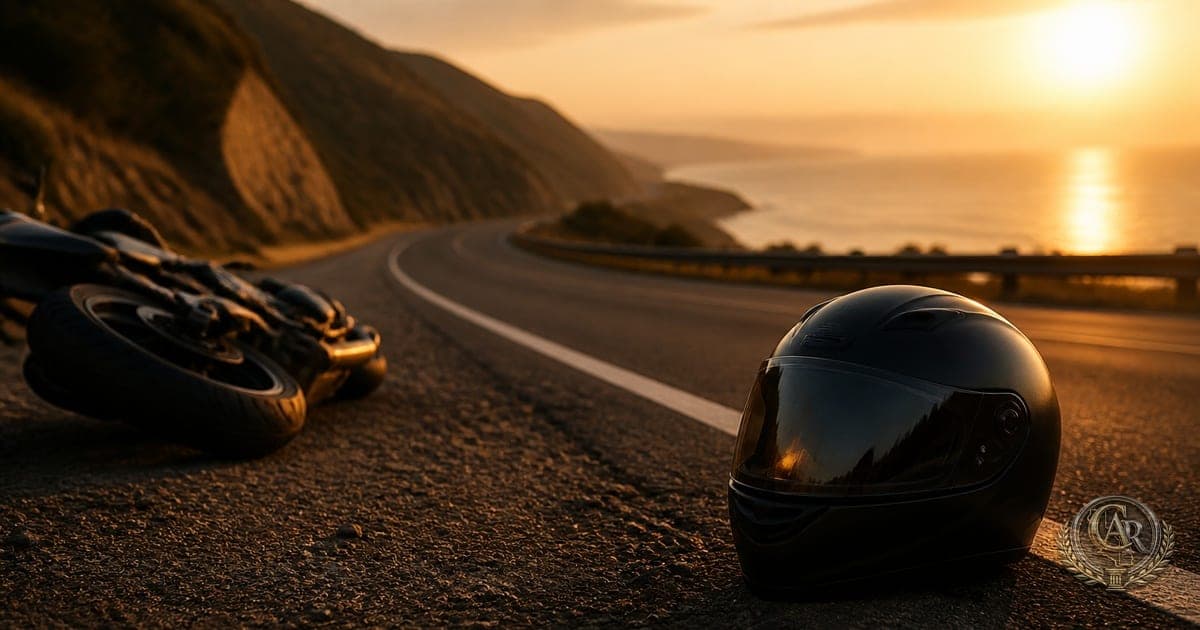
A California motorcycle accident injury claim is a personal injury lawsuit governed by Code Civ. Proc. § 335.1, which gives most riders two years from the crash date to sue for negligence. Recovery depends on proving another party's fault, and California's pure comparative fault rule reduces damages by the rider's share of responsibility. This page explains what the law says. It does not apply that law to any particular crash.
How long do I have to file a motorcycle accident claim in California?
Most California motorcycle injury claims are negligence actions, and the deadline to sue is two years from the date of injury under Code Civ. Proc. § 335.1. Miss it and a court will almost always dismiss the case, regardless of how serious the injuries are.
A few situations shift the clock:
| Claim type | Deadline | Authority |
|---|---|---|
| Personal injury (negligence) | 2 years from injury | Code Civ. Proc. § 335.1 |
| Property damage only (bike, gear) | 3 years | Code Civ. Proc. § 338 |
| Against a government entity | Written claim within 6 months | Gov. Code § 911.2 |
The six-month government window catches many riders off guard. It applies where a public entity is alleged to be at fault, for example a pothole, defective road design, or a city vehicle. Because evidence like skid marks, vehicle positions, and witness memories fades fast, the practical deadline for gathering proof is often much sooner than the legal one.
Proving fault after a crash
California is an at-fault state for motor vehicle collisions. To recover, an injured rider generally must show another party owed a duty of care, breached it, and caused the injury. Common breaches include a driver making a left turn across a rider's path, changing lanes without checking, or following too closely.
Evidence that tends to establish fault:
| Evidence type | What it can show |
|---|---|
| Police collision report | Officer's fault findings, citations, statements |
| Photos and dashcam or helmet-cam footage | Vehicle positions, road conditions, sequence |
| Witness statements | Independent account of the collision |
| Vehicle damage patterns | Point of impact, direction of travel |
| Medical records | Nature and cause of injuries |
Violation of a Vehicle Code rule, for example an unsafe lane change under Veh. Code § 22107, can support a negligence claim. Lane splitting is lawful in California. No statute prohibits it, and Veh. Code § 21658.1 defines the practice and directs the CHP to issue safety guidelines. Splitting lanes is therefore not by itself proof a rider was at fault.
How does comparative fault affect a motorcycle claim?
California follows pure comparative negligence, so if a rider is partly responsible, damages are reduced by the rider's percentage of fault, and the rider can still recover even if mostly at fault. A rider found 40 percent at fault could recover 60 percent of proven damages, subject to other rules.
This rule comes from California case law rather than a single statute and applies across personal injury claims. Insurers often argue a rider was speeding, splitting lanes unsafely, or not wearing a helmet. California's universal helmet law, Veh. Code § 27803, requires riders and passengers to wear a compliant helmet. Riding without one does not bar a claim, but where head injuries were involved it can be raised to reduce the injury-related portion of damages.
Because fault is apportioned by percentage, disputes over responsibility directly move the dollar value of a claim.
Under California's pure comparative negligence rule, a motorcyclist's recovery is reduced in proportion to the rider's own share of fault, and the rider is not barred from recovering even when found mostly responsible. As of September 2026, no statute caps compensatory damages in ordinary motor vehicle negligence cases, unlike the separate limit that applies to medical malpractice. Two exceptions narrow recovery. Punitive damages require clear and convincing proof of oppression, fraud, or malice under Civ. Code § 3294. And under Civ. Code § 3333.4, an uninsured rider, or one convicted of DUI arising from the crash, cannot recover non-economic damages such as pain and suffering, even when another driver caused the collision. These figures and rules can change, so confirm current text before relying on them.
What damages does California law allow?
An injured rider may generally seek two categories of compensatory damages. Economic damages cover measurable losses: medical bills, future care, lost wages, lost earning capacity, and property damage. Non-economic damages cover pain, suffering, disfigurement, and loss of enjoyment of life.
California does not cap compensatory damages in ordinary motor vehicle negligence cases. Punitive damages are available only in narrow circumstances. Under Civ. Code § 3294, a plaintiff must prove oppression, fraud, or malice by clear and convincing evidence, which might apply where a driver was, for example, driving under the influence.
One caveat: under Civ. Code § 3333.4, an uninsured rider (or one convicted of DUI in the crash) is barred from recovering non-economic damages, even when another driver was at fault.
Insurance and the public record
Many crashes are resolved through insurance before any lawsuit. California requires minimum liability coverage, and riders often carry uninsured or underinsured motorist coverage that responds when the at-fault driver has no or too little insurance. That coverage matters because motorcycle injuries are frequently severe.
Steps that tend to preserve a claim under the law: seek medical evaluation promptly (treatment gaps become disputes), report the collision, preserve the motorcycle and gear before repair, photograph everything, and be cautious about recorded statements to the other driver's insurer.
Because deadlines, comparative-fault arguments, and government-claim rules turn on specific facts, some riders consult a personal injury attorney. You can read about the field at /lawyers/personal-injury and confirm any attorney's license status against the public roll through the registry's /attorneys index. California Attorney Registry is an independent index of the public attorney roll maintained by the State Bar of California. It issues no ratings and operates no referral service. For related reading, see how long you have to file a personal injury claim in California and how truck accident claims differ from car crashes.
Legal information, not legal advice.
Legal information, not legal advice. This brief provides general legal and professional information; it is not a substitute for counsel on a specific situation, and reading it creates no attorney–client relationship.